
Thoughts on the Antichrist
How art thou fallen from heaven, O Lucifer, son of the morning!

How art thou cut down to the ground, who didst weaken the nations!
Isaiah 14:12
I think it is time to speak about it. Recently, Peter Thiel was in the media for hosting an off-the-record lecture on the Antichrist. For many this felt a little unsettling. Comedian Tim Dillon pointed out that something does not feel right about the fact that a billionaire obsessed with surveillance systems and AI-powered military technology has also developed an interest in Satan. I would argue it is not a bad time to seriously tackle the notion of the Antichrist and what relevance he has in our time period.
First of all, let us establish what we even mean when referring to the Antichrist. How is he different from Satan, the devil, or any other demonic figure? The Bible applies the term Antichrist in a twofold manner: On the one hand, individuals that work against the teachings of Christ, and on the other, an off-worldly force opposing Christ himself. This second entity is Satan in a new guise, a version of the devil in a world where Christ had walked the earth.
Dear children, this is the last hour; and as you have heard that the antichrist is coming, even now many antichrists have come.
John 2:18
Whether you follow scripture or you study the Christian religion as a historical phenomenon, it is clear that the coming of Christ represents a break within the continuity of history. The devil may appear in various forms, a horned beast, Satan, Beelzebub, Baphomet or Mephisto, but his most horrific form is that of Lucifer, a figure that descends upon the earth around the time of the coming of Christ. With Christ, the abstraction of God becomes concrete alongside its dark opposite, its shadow-image.
It is highly unlikely that the bond between God and man was broken with the death of Christ; on the contrary, the continuity of this bond is stressed again and again and is further confirmed by the sending of the Paraclete. But the closer this bond becomes, the closer becomes the danger of a collision with evil. On the basis of a belief that had existed quite early, the expectation grew up that the light manifestation would be followed by an equally dark one, and Christ by an Antichrist.
Carl Jung. Answer to Job.
As Jung mentions, in its origins we are witnessing the return of a much older idea that was first discovered among the Zoroastrian religion of ancient Persia. Through the teachings of Zoroaster, the diverse pantheon of the Iranian plateau had been incorporated into a duality of two opposing forces. This initial emergence of metaphysics reduced deities to mere aspects of a duopoly of overarching mega-gods called Ahuramazda and Ahriman.
However, the formation of the Christ-Antichrist polarity triggered an even more profound rupture through the center of our metaphysical conceptions of God. Lucifer is no ugly beast, not a man-eating creature, but the angel of light, the most capable and beautiful of the creatures of heaven. The Gnostics believed the snake in the Garden of Eden to be Christ, as he liberated man from the confines of the evil impostor God of the Old Testament. The Gematria of ancient Hebrew encodes “Messiah” with the same numerology as “Snake”. Christ brought the light and made blind people see. We are dealing with a profound duality within the figure of Christ.
In some sense, the Antichrist as an idea is something that really comes into being in the world after Christ … And then there’s a lot of things about it that are mysterious. In some ways, the Antichrist copies Christ, the Antichrist pretends to be greater than Christ, hyper Christian, ultra Christian, and then maybe only ultimately, deeply anti-Christian.
Peter Thiel
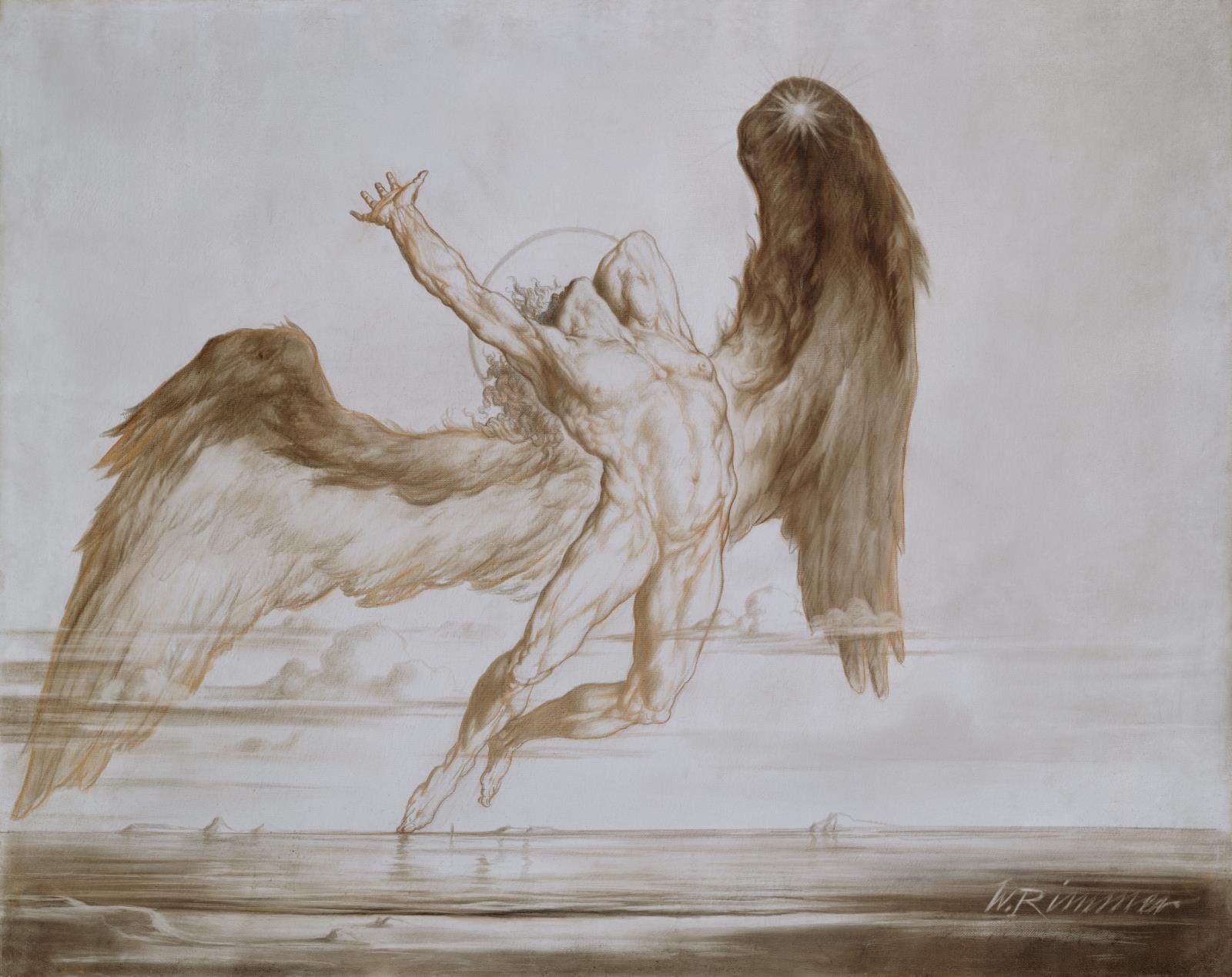
What exactly induced the fall of this archangel, why would God create an adversary for himself? The biblical tradition leaves little clues about the origin of Lucifer or the Antichrist. All we know is that he was once expelled from heaven, allegedly for his pride and desire to become God. This divine punishment for prideful hubris is reminiscent of the Tower of Babel, a project that strove to allow humans to reach heaven by their own efforts.
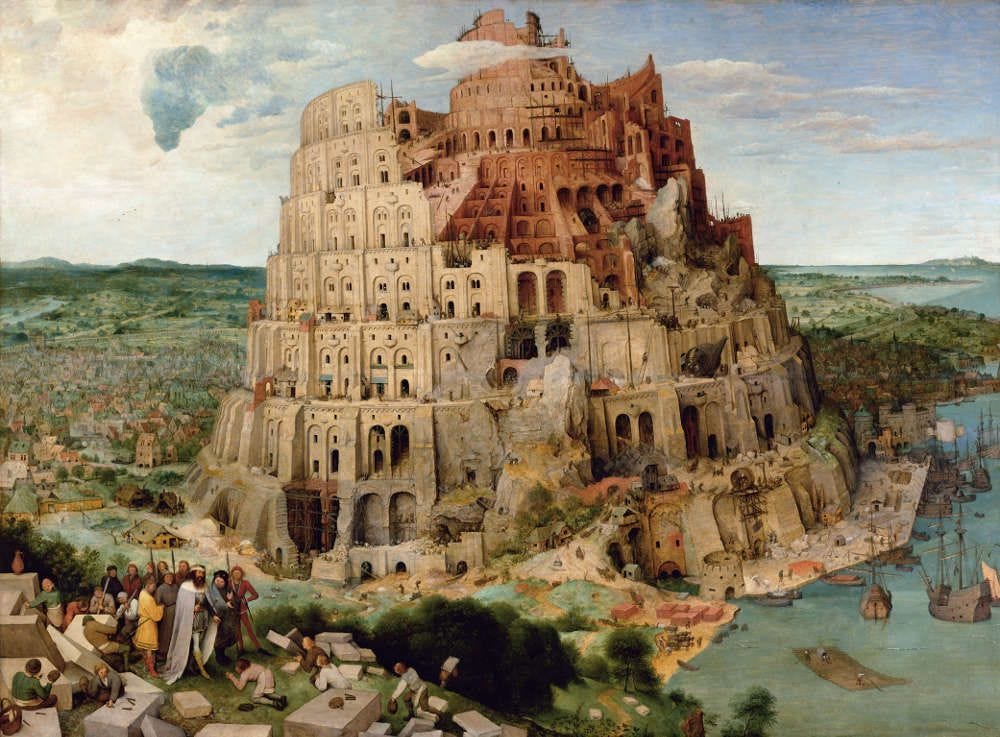
Come, let us build ourselves a city, with a tower that reaches to the heavens, so that we may make a name for ourselves; otherwise we will be scattered over the face of the whole earth.
Genesis 11:4
Interestingly enough, the most profound description of Lucifer was made by John Milton in the 17th century, right when the Reformation had been leading a religious revival, breaking with the tradition of the Roman Catholic Church. Here, the origin of man, the drama at the garden of Eden, is at the centre of the story. It took ‘fan-fiction’ rather than canonical bible scholarship to elucidate the idea of Lucifer.
Infernal world, and thou profoundest Hell
Receive thy new possessor: one who brings
A mind not to be changed by place or time.
The mind is its own place, and in itself
Can make a Heaven of Hell, a Hell of Heaven.
… Better to reign in Hell, than serve in Heaven.John Milton. Paradise Lost.
The story of Paradise Lost illustrates Lucifer’s rise from the pits of hell. His ascent to the world of man matches the idea of the Antichrist appearing as a false prophet to rule the world at the end of times. The Reformation represented an explosion of new approaches to bible study and has lead to a multitude of Christian sects discovering new interpretations of the Gospels. At the same time, however, this newfound religious fundamentalism simultaneously paved the way for the so-called enlightenment. Who exactly was the bringer of light again?
Let us keep track of two crucial developments of early modernity by looking at British parliament in the 17th century: On the one hand, we observe the rise of Puritanism as a radical fundamentalist form of Protestantism. At the same time, most Puritans were members of the Independents in parliament, advocating for religious freedom and therefore laying the groundwork for the ensuing principles of free expression and humanism.
It should not be forgotten, that this enlightenment only happened within the context of Western Christendom, which at the time was a combination of a Christianised Germanic north in rebellion against a neo-Roman empire that had institutionalised Christianity in its imperial structure. There is something strangely Christian about this rise of secularism and subsequent general apostacy. Arguably, it was foretold in the book of Revelations that Christianity would negate itself and the world would be ruled over by the Antichrist. Perhaps this was a dialectical necessity, as the collective spirit of Christendom cannot maintain Christ’s doctrine in its pure form, until it eventually inverts into its opposite. As Goethe’s Mephisto exclaims:
I am the spirit that negates.
And rightly so, for all that comes to be
Deserves to perish wretchedly;
‘Twere better nothing would begin.
Thus everything that your terms, sin,
Destruction, evil represent—
That is my proper element.Johann Wolfgang von Goethe. Faust. Der Tragödie erster Teil.
Our civilisation, that is, the West, is no longer Christian, but Faustian. Faust represents a character in Goethe’s most classic play on a learned man who sells his soul to the devil in order to gain power and influence within this earthly realm. The story mirrors the story of Job, where God makes a bet with the devil over the soul of Faust. Nobody can deny that mankind has elevated its own reason and rationality above God and has begun worshipping its own intellect. Human ingenuity, it is said, has liberated us from the toil and suffering of the past. Our technology has cured diseases, increased our lifespans, and has made life overall more safe and worthwhile for many of us.
This last idea never thereafter let go its hold on us, for success would mean the final victory over “God or Nature” (Deus sive Natura), a small world of one’s own creation moving like the great world, in virtue of its own forces and obeying the hand of man alone. To build a world oneself, to be oneself God — that is the Faustian inventor’s dream, and from it has sprung all our designing and re-designing of machines to approximate as nearly as possible to the unattainable limit of perpetual motion.
Oswald Spengler. Man and Technics.
Yet, we seem to be haunted by the idea that the fate of Babel is upon us. Horror scenarios about the rise of AI, the techno-capital singularity, or the global network of technocratic surveillance-control are ubiquitous. We can hear the never-ending lamentations about the destruction of our biosphere and the ever-accelerating annihilation of species and traditional languages and cultures. Decline is seen everywhere. Has our civilisation in fact entered a pact with the devil?
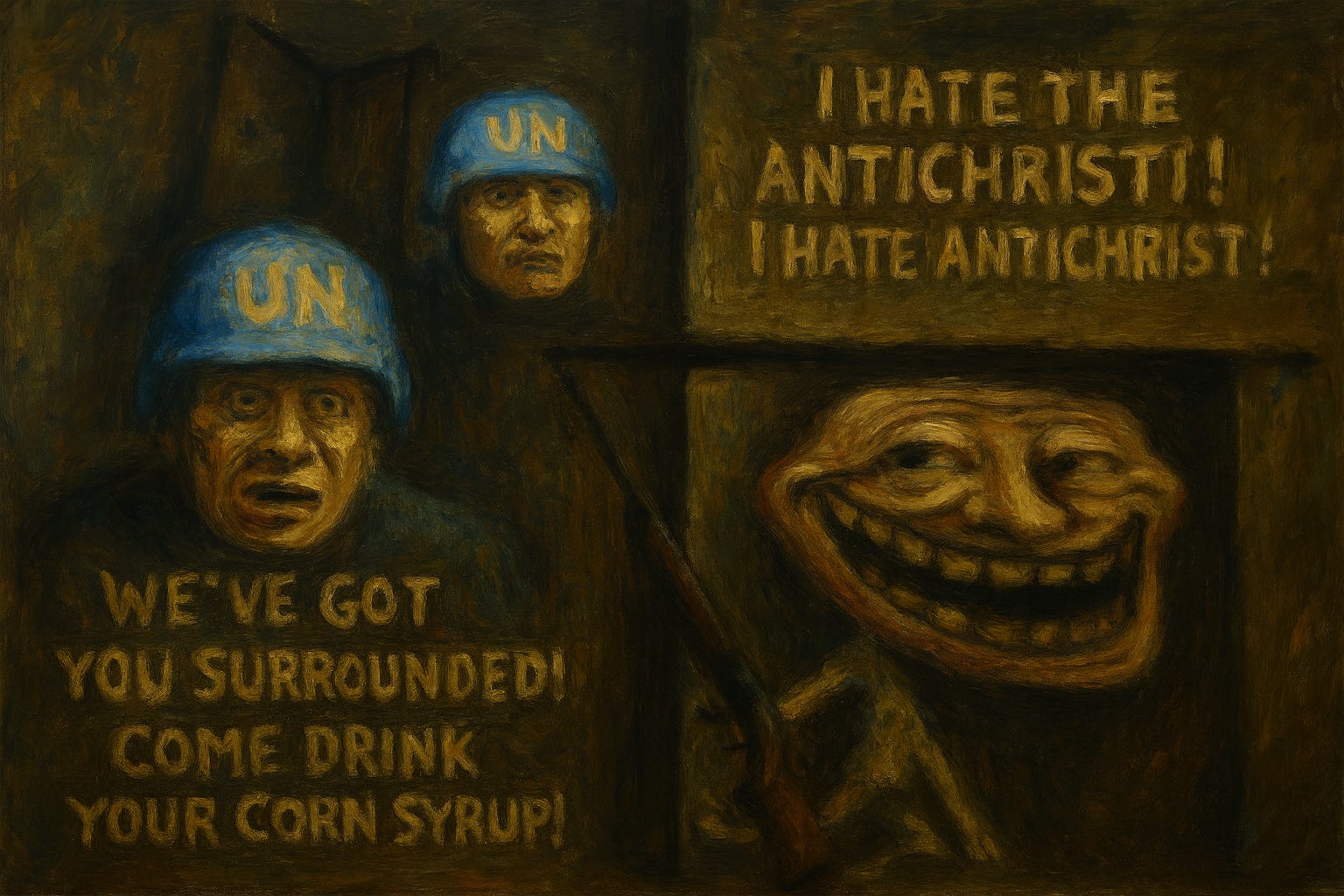
the Sole agent of revolution, the Antichrist is not one but many, a swarm of masked infiltrators from the future, ‘poised to eat your TV, infect your bank account, and hack mitochondria from your DNA’;
Nick Land. Fanged Noumena.
This brings us to the possible conclusion that we have in fact already begun with the construction of a new Tower of Babel, an Antichrist system of total control. Only the utter subjugation of mankind offers the sufficient sacrifice to elevate Lucifer to the position of God. We no longer worship God, but a false prophet, a phony impostor. The aforementioned Gnostics referred to the evil impostor God as the Demiurge, a name derived from Plato’s creator god as described in the Timeus.
And when he saw the multitude of the forms which had been made by the image of the invisible Spirit, he became arrogant, saying, ‘It is I who am God, and there is none apart from me.’ And a voice came forth from above the realm of authority, saying, ‘You are mistaken, Samael’—that is, ‘god of the blind.’
Apocryphon of John
Modern science, driven by the Faustian pursuit of total knowledge, has long begun its search for an all-encompassing model of the cosmos. From the days of Decartes and later Laplace, the universe was said to work like a divine clockwork. God had already been reduced to a Deistic mechanism, an amalgamation of formal laws of nature. These laws are still treated as subjects of human inquiry, as though we were able to understand and manipulate the plans of God. Science has built its idol, its demiurge to worship in place of God.
To say that a stone falls to Earth because it is obeying a law makes it a man and even a citizen.
C.S. Lewis
The scriptures leave us in the dark about the meaning of our current developments. Is the false messiah the superhuman AI we are building? Or will it be a misleading figure, claiming to promote a return to the original Gospels? To what extent is any return to Christianity merely a delaying force, perpetually postponing the necessary rise and fall of beast?
And the beast was taken, and with him the false prophet that wrought miracles before him … These both were cast alive into a lake of fire burning with brimstone.
Revelations 19:20