
Contemporary Dynamics
Modern Physics has moved into postmodernity and is yet still burdened by its past.

Approaching the end of the nineteenth century, the takeover was almost complete. The entire universe was ruled by a fixed set of laws which we had almost totally discovered and formalised. At least in principle, Laplace’s Demon would be able to determine the movements and trajectories of every particle, as long as the initial conditions (position and velocity) were known. The profound uniformity of the laws of nature were carried by the assumption of absolute space and time. There was one infinitely large Cartesian box that contained everything, all matter and energy and its movements could be determined due to the fact that time was simply an imagined fourth coordinate axis that was moving uniformly throughout the cosmos.
Giordano Bruno, who was a contemporary of Galilei had already hinted at the possibility of time passing at different speeds in different parts of the universe. If each star represented another solar system and there was a potentially infinite amount of worlds like ours out there, time must necessarily pass differently on each planet. Bruno argued this based on the Aristotelian conception of time being the number of motion. If we measure our days by the rotation of the earth around its axis, days would be longer or shorter depending on each planet’s speed of rotation.
Si tempus ponatur nobis, ut Aristoteli, mensura motus, … tot sane erunt in universo tempora, quot sunt et astra. … si nos essemus in alia astra, apertissime constaret brevissimum motum omnium esse alium ab isto, sicut in luna constat alium esse motum diurnum, ubi octo et viginti dierum spatia … quod hoc astrum, tellus, spatia viginti quatuor horarum.
[EN]
If time is posited, as it is for Aristotle, as the measure of motion … then there will indeed be in the universe as many times as there are stars. … If we were upon another star, it would be wholly evident that its shortest motion was different from ours; just as on the moon its daily motion is different, taking twenty-eight days, whereas this star, the Earth, takes twenty-four hours.
Porro, Pasquale, ed. The Medieval Concept of Time: Studies on the Scholastic Debate and Its Reception in Early Modern Philosophy. Studien und Texte zur Geistesgeschichte des Mittelalters 75. Leiden, Boston, and Cologne: Brill, 2001. [19]
Bruno and Galilei can be seen as pioneers of the scientific revolution with different approaches. Their difference, however, did not express itself in open dispute, as they were still both threatened by the same Scholastic authority they both opposed. It took until the debates between Newton and Leibniz when the distinction between absolute space and time and a more relative conception became more prominent. In hindsight, Newton clearly dominated this debate, whether for scientific or political reasons. It was only until Albert Einstein developed his theory of relativity that absolute space and time had to be dropped.
Einstein’s theory of relativity addressed one of the two major unresolved problems that, according to Lord Kelvin, were plaguing physics at the time. It is said that people were claiming that save for these two issues, physics was almost complete and there was little sense in pursuing it as a field of further research. The first issue was the unexplainable fact that hot bodies emitted radiation and the second one was the Ether drift. The Ether represented a last attempt at holding on to a Laplacian (mechanistic) universe, where the phenomenon of light, or electromagnetic radiation, was explained as waves of density in a profoundly subtle medium, an echo of the Aristotelian Quintessence. By finding a way to somehow explain radiation as propagating within a universal see of ubiquitous material stuff, some scientists wanted to explain it all by assuming the world was made of many tiny springs or oscillators. But the reign of pure mechanistic science had to come to an end.
The beauty and clearness of the dynamical theory, which asserts heat and light to be modes of motion, is at present obscured by two clouds. I. The first came into existence with the undulatory theory of light, and was dealt with by Fresnel and Dr. Thomas Young; it involved the question, how could the earth move through an elastic solid, such as essentially is the luminiferous ether? II. The second is the Maxwell–Boltzmann doctrine regarding the partition of energy.
Lord Kelvin https://en.wikiquote.org/wiki/William_Thomson
As a slightly alternative current to purely mechanistic science, field theorists emerged right after Newton. Some of their most prominent representatives like Faraday and Maxwell were intensely religious thinkers, and this was arguably not a coincidence. In fact, they continued the Newtonian tradition that understood absolute space and time to be derivative of the immensity of God. Hence, they sought to explain forces in terms of fields that were ubiquitous and acted always everywhere at once. The dismemberment of God as an absolute principle that Leibniz had lamented about Newton’s science therefore took on two competing versions. One was the attempt to understand each of the forces of nature separately as mechanisms. The other was the idea that forces themselves were expressions of fields that constituted time and space instead of occurring within them.
Coming back to Kelvin’s second issue, known as the Ether drift, it was observed by Michelson and Morley in 1887 that light had the same velocity at all times, regardless of whether the inertial system from which it was emitted was in motion or not. This meant that the Ether had to be always moving along with the light emitting source. This would directly disprove the idea of absolute space and time or at least push it into metaphysics and make it irrelevant for the study of physics. If Ether moved relative to bodies all the time, the entire point of having a universal medium for radiation became superfluous and absolute space and time were no longer observable in any way.
Michelson-Morley experiment, an attempt to detect the velocity of Earth with respect to the hypothetical luminiferous ether, a medium in space proposed to carry light waves. First performed in Germany in 1880–81 by the physicist A.A. Michelson, the test was later refined in 1887 by Michelson and Edward W. Morley in the United States.
The procedure depended on a Michelson interferometer, a sensitive optical device that compares the optical path lengths for light moving in two mutually perpendicular directions. Michelson reasoned that, if the speed of light were constant with respect to the proposed ether through which Earth was moving, that motion could be detected by comparing the speed of light in the direction of Earth’s motion and the speed of light at right angles to Earth’s motion. No difference was found. This null result seriously discredited the ether theories and ultimately led to the proposal by Albert Einstein in 1905 that the speed of light is a universal constant.
https://www.britannica.com/science/Michelson-Morley-experiment
The field theories rose to victory as most notably Maxwell’s field equations seemed to be unharmed by the abolition of Ether. The mechanisation that started with Descartes had to yield to the idea that forces were carried by fields that were beyond time and space. In the first step, the need for fields to keep the velocity of light unchanged was mathematically formalised by the famous Lorentz Transformations. Without having taken them into account, Maxwell had formulated laws of electrodynamics that were invariant under these transformations and hence passed the test of time. Now mechanics, the domain that still had to occur within time and space had to be updated, a feat that was accomplished by Einstein’s Special Relativity.
Einstein showed that time and space could not be seen as absolute frameworks, but were entirely relative, meaning they were dependent on the relative motion of bodies. There was no longer a means of claiming that a body was absolutely in motion or at rest, as it could only be so relative to other bodies. Seemingly, one of Kelvin’s problems was resolved, but it did not lead to the completion of physics, but instead triggered a ripple effect of creating further, even more fundamental issues that would ensure the continuation of physics as a field of research for a long time.
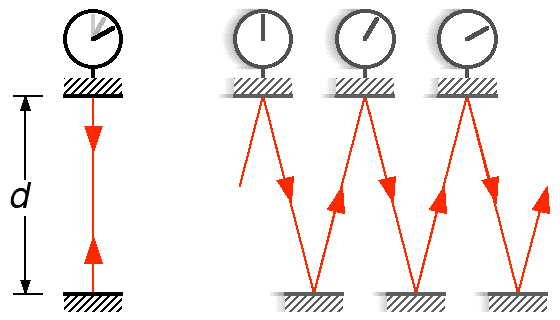
In the meanwhile, Einstein, alongside Planck, later followed by Bohr, Heisenberg, Pauli and Schrödinger discovered an answer to Kelvin’s first issue concerning the radiation emitted by hot bodies. They discovered a formalism that described energy and matter interchangeably as quantised particles and waves. Quantisation meant assuming a discreteness of nature that, similar to Relativity, had deeper implications for modern physics. The universe came to be seen as probabilistic and no longer concretely determined, rendering even position in time and space as not inherently set. This inherent nonlocality of quantum mechanics represented a turning point in physics, a departure from which onwards theories were categorised into classical and modern physics. Einstein’s relativity remains to be seen as the last theory of classical physics in the vein of Newton, whilst quantum physics with its constituent quantum mechanics and quantum field theories are squarely placed within the category of modern physics.
Whenever we try to deduce laws from our study of atomic phenomena, we discover that we no longer correlate objective processes in space and time, but only observational situations. Only for these can we derive empirical laws. The mathematical symbols with which we describe such observational situations represent possibilities rather than facts. One might say that they represent an intermediate stage between the possible and the factual, which can only be called objective in the sense that, say, temperature is called objective by statistical thermodynamics.
Our knowledge about what is possible does admittedly enable us to make a few clear predictions, but, as a rule, it only allows us to speculate as to the probability of a future event.
Heisenberg, Werner. Physics and Beyond: Encounters and Conversations. Translated by Arnold J. Pomerans. New York: Harper & Row, 1971. [13]
Today, physics constitutes a hybrid of modern and classical theories, as a complete picture of all known fundamental forces requires us to apply general relativity in order to account for gravitation, whilst all the other forces can be modelled to varying degrees by quantum theories. The cascading consequences that both resolutions to Kelvin’s problems brought led to two competing theories with fundamentally irreconcilable contradictions.
Special relativity explained time and space as being dependent on inertial systems and their relative motion to other such systems. A cascading issue, however, was the question of force and inertia. Force represents a change of motion, a measure that, unlike linear homogeneous motion, can be sensed and measured without any external comparative standard. Here, Bernard Riemann and Ernst Mach laid the groundwork for Einstein to accomplish a second, more thorough blueprint for relative spacetime known as general relativity. Mach’s principle asserts that inertia, the inherent ‘urge’ for bodies to resist a force, originates from the conflicting force exerted on each body by the presence of all energy and matter throughout the entire universe. All that Einstein needed to do was to find a way to incorporate the distribution of energy and matter into his relativity of time and space. Initially, Minkowski space had laid the groundwork for this, as it was the first attempt at defining a global system of coordinates that incorporated the relativistic contractions of time and space. This space now needed to be distorted, or rather curved by the presence of energy and matter. Riemann curvature provided the necessary ingredient for the completion of general relativity.
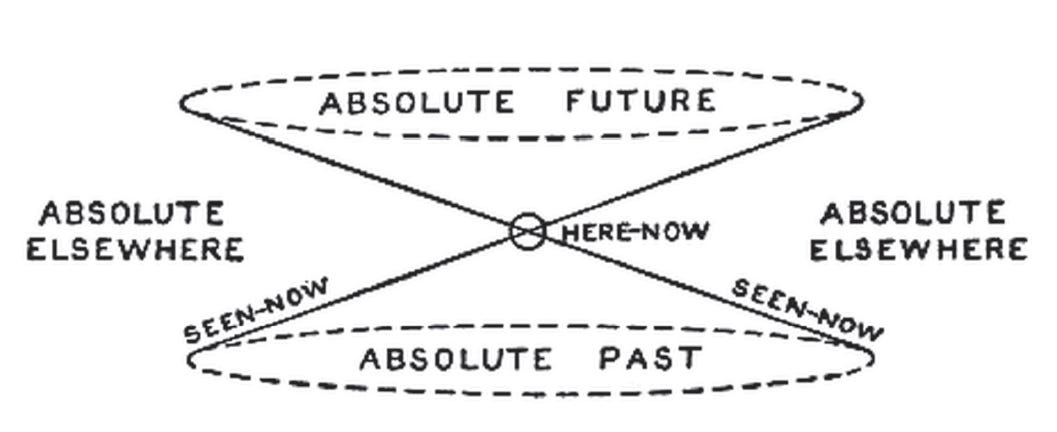
The appearance of a four-dimensional world in this subject is due to Minkowski. Einstein showed the relativity of the familiar quantities of physics; Minkowski showed how to recover the absolute by going back to their four-dimensional origin and searching more deeply.
Eddington, Arthur Stanley. The Nature of the Physical World: The Gifford Lectures, 1927. New York: The Macmillan Company; Cambridge, England: Cambridge University Press, 1929. [5]
Relativity theory saved the clock. Time and space were merged into a single, interwoven spacetime and this in turn enabled us to coordinate time across space again. One of the pressing issues that were sought to be solved by Einstein was the fact that it seemed practically impossible, or at least much more difficult than expected, to synchronise clocks across territories. Train stations urgently needed to be able to align clocks and hence it is plausible to say that whilst initially disproving the theoretical possibility of absolute spacetime, Einstein effectively restored absolute space and time by giving it a new form. What had originally been the three and later four-dimensional continuum described by Descartes was now generalised to the spacetime manifold, curved spacetimes that were locally indistinguishable from our conventional Cartesian (or Newtonian) spacetime. It was as though a theory had restored the idea of a flat earth, by describing the globe as a curved entity that was perfectly flat on each point of its surface.
General Relativity is considered to be part of classical physics for the wrong reasons. Generally, it is said to lack quantisation or cannot be quantised and is therefore not reconcilable with quantum theories. The way in which the formalism of general relativity is applied indicates that curved spacetimes really are treated as restored versions of absolute spacetime. This can be seen in the application of the theory to cosmology. It is assumed that the entire universe in its genesis and ongoing development can be attributed with a single spacetime that encodes all causal information about the entire cosmos. The mathematical formalism of general relativity does not necessitate this causal closure at all, but it has become common practise to limit spacetime manifolds to those cases in which full causality is ensured. This does not only apply to the edge case of cosmological models, but also includes black holes where the postulate of cosmic censorship states that any occurring breakdown of causality (e.g. in the vicinity of a black hole singularity) is fenced off by an event horizon, rendering the ‘regular’ region of spacetime outside of this horizon to remain fully causal. Given this circumstance, it is correct to categorise the contemporary interpretation of general relativity as classical, however, the implications of the theory by no means necessitate us to ‘remain classical’.
Was früher in der Mikrophysik eine praktische Schwierigkeit war, ist heute, infolge der Unbestimmtheitsrelation, eine prinzipielle Unmöglichkeit geworden; und dasselbe könnte eines Tages auch für die Schwierigkeiten eintreten, die nicht auf einem ‘zu klein’, sondern auf einem ‘zu groß’ beruhen.
[EN]
What was formerly a practical difficulty in microphysics has today, owing to the uncertainty relation, become a principled impossibility; and the same might one day happen to difficulties arising not from something being ‘too small,’ but from something being ‘too large.’
Gödel, Kurt. Eine Bemerkung über die Beziehungen zwischen der Relativitätstheorie und der idealistischen Philosophie. In Albert Einstein als Philosoph und Naturforscher, edited by Paul Arthur Schilpp, 406–12. Braunschweig: Friedr. Vieweg & Sohn, 1979. [7]
The contemporary understanding of what would need to be attempted in order to ‘quantise’ general relativity runs under the classical assumption that quantisation signifies the ‘making discrete’ as in ‘dividing up’ continuous spacetime into microscopic chunks. Moreover, it is implicitly assumed that quantum processes would have to be occurring within this quantised spacetime, given the classical understanding of spacetime as an empty receptacle within which mechanics takes place. From its outset, it needs to be emphasized that quantum theory does not incorporate a single Hilbert space or wavefunction for the entire cosmos. In fact, there is no absolute cosmology as such even possible. This was, among other reasons the circumstance that triggered Einstein, Podolski and Rosen to consider quantum mechanics to be fundamentally incomplete, as it lacked the causal closure that was necessary to construct a cosmological world-model. However, it was made clear by Kurt Gödel that such a world-model is similarly made impossible by the implications of general relativity.
While we have thus shown that the wave function does not provide a complete description of the physical reality, we left open the question of whether or not such a description exists. We believe, however, that such a theory is possible.
Einstein, Albert, Boris Podolsky, and Nathan Rosen. Can Quantum-Mechanical Description of Physical Reality Be Considered Complete? Physical Review 47, no. 10 (1935): 777–80. [6]
Finally, since we take quantum mechanics as a complete description of the world at the present level of experimental knowledge … we are forced to accept the result that there is no objective, or more precisely observer-independent meaning to the ascription of a property to a system. Thus, the properties of the systems are to be described by an interrelated net of observations and information collected from observations.
Rovelli, Carlo. Relational Quantum Mechanics. International Journal of Theoretical Physics 35, no. 8 (1996): 1637–78. Preprint, arXiv:quant-ph/9609002v2. [20]
Each set of observations made of a quantum system defines its own space of state vectors, just like each point on the spacetime manifold defines its own Euclidean tangent space. But unlike in general relativity, it is generally accepted that there is no overarching cosmological quantum super-state-space that incorporates all possible quantum systems. Quantum systems stand in a fleeting (implicitly continuous) relation to one another. Therefore, quantum mechanics does not even imply the possibility of an overarching quantised cosmological space. Instead, quantisation is given by the non-commutability of operations on a quantum system. Each operation or observation establishes a reality that the subsequent operation acts on. Bell’s theorem demonstrates that there is no underlying consistent (local) reality that prefigures both operations.
The paradox of Einstein, Podolsky and Rosen was advanced as an argument that quantum mechanics could not be a complete theory but should be supplemented by additional variables. These additional variables were to restore to the theory causality and locality. In this note that idea will be formulated mathematically and shown to be incompatible with the statistical predictions of quantum mechanics. It is the requirement of locality, or more precisely that the result of a measurement on one system be unaffected by operations on a distant system with which it has interacted in the past, that creates the essential difficulty.
Bell, J. S. On the Einstein Podolsky Rosen Paradox. Physics 1, no. 3 (1964): 195–200. [3]
The misunderstanding of the nature of quantisation does not imply a lack of skill or knowledge among trained physicists throughout the last century. Instead, it implies that the falsifications that prompted us to do away with absolute space and time effected changes in our mathematical formalism, but kept the underlying ontological paradigm intact. Especially the contemporary attitude that treats the quantisation of general relativity as a step towards grand unification shows that we are still regarding physics as a field that is approaching some sort of completion. Instead of attempting this completion, what is required is a more thorough break with the current paradigm and the resulting revelation of even deeper problems to tackle.
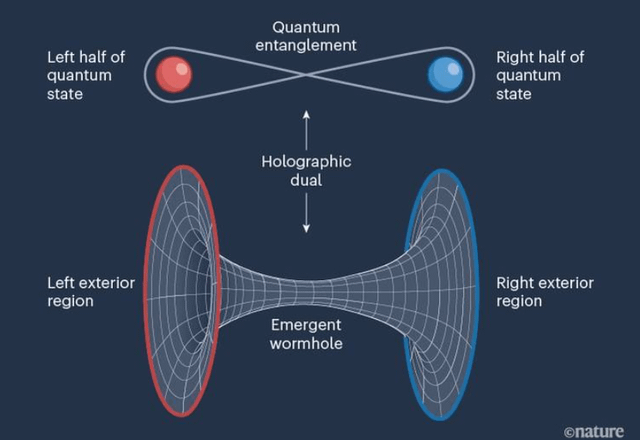
One can argue that quantisation has been incomplete. Whilst we have successfully demonstrated nonlocality by turning position and momentum to non-commuting operators (meaning that position and momentum cannot both be observed at the same time, resulting in the position inherently being uncertain or somewhat blurry/fuzzy), we are yet to demonstrate non-temporality. In principle, energy and time are supposed to have the same non-commutative relationship, yet there is no corresponding time operator to the energy (or Hamiltonian) operator that could demonstrate the quantisation of time. Therefore, time in quantum mechanics remains as a classical variable, as indicated by the time parameter for unitary transformations and time-dependent operators.
Wenn Impuls und Ort solche inkommensurable physikalischen Grössen sind, so ist es aus Gründen der relativistischen Viererdarstellung […] eine naheliegende Folgerung, daß dasselbe für Energie und Zeit zu gelten hat. In der Tat gibt es ebenso wie eine Impuls-Orts-Unschärfe eine Energie-Zeit-Unschärfe, die in zahlreichen Situationen experimentell bestätigt ist. Das erstaunliche Faktum hierbei ist aber, daß demgegenüber bislang kein Konsens über einen quantenmechanischen Zeitoperator besteht, der für die dazugehörige Inkommensurabilität von Energie- und Zeitoperator erforderlich ist. Dies ist nach wie vor, auch in den moderneren Formulierungen der Quantentheorie […] ein fundamentales Problem.
[EN]
If momentum and position are such incommensurable physical quantities, then, for reasons of the relativistic four-dimensional formulation […], it is a natural conclusion that the same must hold for energy and time. Indeed, just as there is a momentum–position uncertainty relation, there is also an energy–time uncertainty relation, which has been experimentally confirmed in numerous situations. The remarkable fact, however, is that no consensus has so far emerged on a quantum-mechanical time operator, which would be required for the corresponding incompatibility of energy and time operators. This remains, even in more modern formulations of quantum theory […], a fundamental problem.
Atmanspacher, Harald. Raum, Zeit und psychische Funktionen. In Der Pauli-Jung-Dialog und seine Bedeutung für die moderne Wissenschaft, edited by Harald Atmanspacher, Hans Primas, and Eva Wertenschlag-Birkhäuser, 239–274. Berlin and Heidelberg: Springer-Verlag, 1995. [1]
A quantum observation represents a discontinuation of a continuous temporal flow. Only during the instance of observation does a quantum system reduce to a particular state. Before that, its state represents a continuous distribution. As there is no time quantisation, observations can be done at arbitrary and irregular time intervals. It becomes clear that quantisation does not result in a coarse graining or kind of ‘pixelation’ of the world. The discretisation of the continuum occurs during the reduction of the probabilistic state to a definitive measurement or observation. This is known as the reduction or collapse of the wave function.
The interpretation of how exactly the wave state and the particle correspond to each other on an ontological level has led to a certain level of controversy and disunity about the interpretation of quantum mechanics. The most common approach, being the Copenhagen interpretation (by Heisenberg and Bohr) or ‘shut up and calculate’ method simply abstains from any clarification and leaves our understanding at the superficial level where wave and particle are simply regarded as complementary to one another. Other approaches, such as the Many Worlds Interpretation state that each observation result occurs simultaneously in parallel realities. In order to avoid ontological baggage, we will proceed with a classic Aristotelian model where the observation is a concrete actualisation of a general potentiality expressed in the probabilistic form of the state or wave function.
The Copenhagen interpretation of quantum theory starts from a paradox. Any experiment in physics, whether it refers to the phenomena of daily life or to atomic events, is to be described in the terms of classical physics. The concepts of classical physics form the language by which we describe the arrangement of our experiments and state the results. We cannot and should not replace these concepts by any others. Still the application of these concepts is limited by the relations of uncertainty. We must keep in mind this limited range of applicability of the classical concepts while using them, but we cannot and should not try to improve them.
Heisenberg, Werner. Physics and Beyond: Encounters and Conversations. Translated by Arnold J. Pomerans. New York: Harper & Row, 1971. [13]
Yet we still encounter issues reminiscent of Zeno’s paradox. The infamous quantum Zeno paradox states that if we increase the amount of times in which we observe a quantum state within a certain time period, the state tends to stabilise. This means that the probability of observing the same state as previously measured increases. In its limit case towards infinite observations or perpetual observation, the state would become entirely classical and lose its probabilistic nature. This means that mere temporal frequency of observation allows an otherwise uncertain quantum state to be turned into a certain one. This exemplifies further the loophole that the non-quantised time variable brings into the quantum model1.
A simple natural approach to this problem leads to the startling conclusion that an unstable particle which is continuously observed whether it decays will never be found to decay!
Misra, B., and E. C. G. Sudarshan. The Zeno’s Paradox in Quantum Theory. Journal of Mathematical Physics 18, no. 4 (1977): 756–63. [18]
It should be clear by now that quantisation originates from (seemingly arbitrary) discontinuity rather than uniform chunking of a continuum. In this sense, the quantum model forces us to go back further than the Leibniz-Newton controversy. Despite Leibniz recognising the fact that time and space could not be defined as an absolute continuum, he nonetheless worked under the assumption of a single unified (and most optimal) world. This world was given and already existing, only that time and space came to be derived from events occurring within it. The quantum model assumes that the world is not already existent, but each act of observation, each discontinuity makes its contribution to the overall creation of the cosmos.
For Wheeler, it wasn’t so much a Kantian inclusion of the observer in our knowledge of the world, but rather a more Jamesian ‘possibilist’ approach in which observers were involved as agents (or ‘participators’ as he called them) in the very creation of the objective world through the questions they pose, which are acts of will, nature then providing random answers from the sea of possibilities, some family of which has been selected out by the participator’s chosen question. As he puts it: ‘the observer-participator converts conceivability into actuality.
Atmanspacher, Harald, and Dean Rickles. Dual-Aspect Monism and the Deep Structure of Meaning. New York: Routledge, 2022. [2]
The idea of discontinuous creation echoes the medieval debates on the nature of creation by God. The core disputes over the role of God pertained to the question that if the universe and with it time itself began at the moment of creation, how free and arbitrary was God’s decision to create the universe? Given that only the discrete countability of motions such as the daily cycles allowed us to measure time, another necessary clarification became the relationship between discrete and countable time versus the flow of continuous eternity. Time and again rational models of nature revealed themselves to be insufficient as they required the seemingly arbitrary intervention of God to maintain a stable cosmos. It is becoming clear that the workings of God in the medieval sense can be regarded as an analogy for the function of a participatory observer in modern physics. In the humanistic vein of the scientific revolution, man had truly put himself at the centre of the universe.
When we delve deeper, we come to understand that even the medieval cosmological model was too much burdened by the ontological baggage of its theology. The thus far explored dissolution of the given objective world, found both in general relativity and quantum mechanics, takes us to back even further. The discoveries of Gödel guide us there. In 1949, Gödel demonstrated the need to entirely do away with objective time and space in his famous solution to Einstein’s field equations, in which he proved the possible existence of a universe in which closed time-like loops were possible, or in other words, where time-travel was possible. In a general sense, this showed that a global time variable was not generally provided in our method of modelling the cosmos.
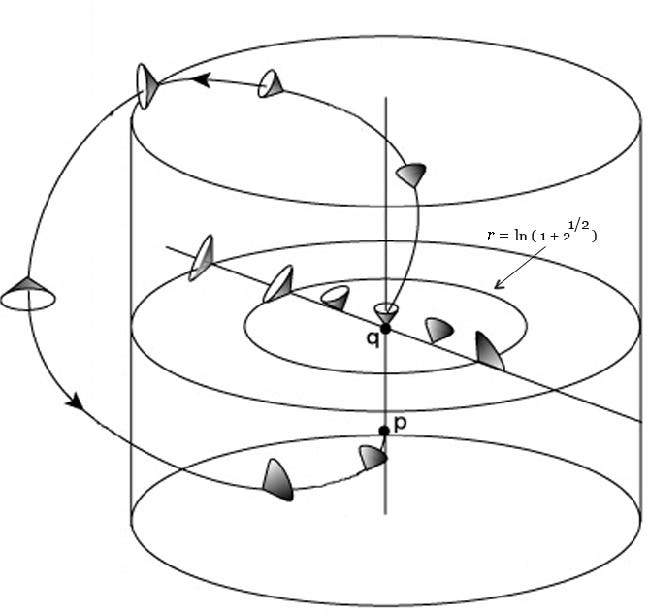
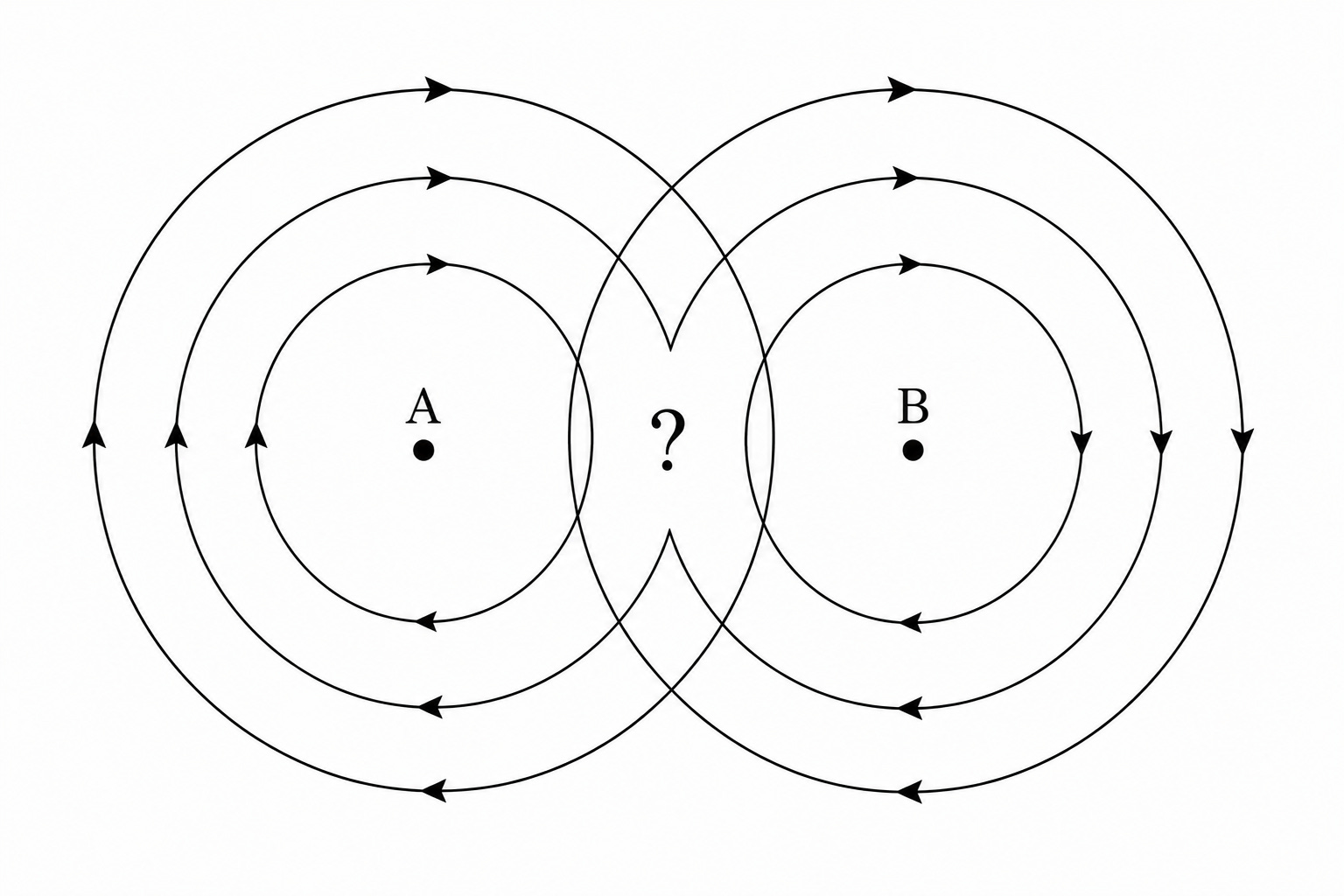
Gödel’s cosmos described a rotating universe that rotated around every point in the spacetime. This necessarily strikes us as nonsensical and contradictory. The intuitive reaction of the scientific consensus was to simply reject time-travel and render it a conceptual impossibility, without paying attention to the deeper implications that Gödel’s observations have. The fact that a rotating universe from the perspective of two observers results in fundamentally irreconcilable times and spaces led Gödel to the conclusion that the laws of nature must stand outside of time and space in a meaningful way.
Every world line of matter occurring in the solution is an open line of infinite length, which never approaches any of its preceding points again; but there also exist closed time-like lines. In particular, if P,QP,QP,Q are any two points on a world line of matter, and PPP precedes QQQ on this line, there exists a time-like line connecting PPP and QQQ on which QQQ precedes PPP; i.e., it is theoretically possible in these worlds to travel into the past, or otherwise influence the past.
Gödel, Kurt. An Example of a New Type of Cosmological Solutions of Einstein’s Field Equations of Gravitation. General Relativity and Gravitation 32, no. 7 (2000): 1409–17. Originally published in Reviews of Modern Physics 21, no. 3 (1949): 447–50. [9]
Wenn wir die Konsequenzen dieses seltsamen Sachverhalts verfolgen, kommen wir zu sehr weitreichenden Schlüssen über das Wesen der Zeit. Es scheint, kurz gesagt, daß man einen eindeutigen Beweis für die Ansichten jener Philosophen erhält, die, wie Parmenides, Kant und die modernen Idealisten, die Objektivität des Wechsels leugnen und diesen als eine Illusion oder als eine Erscheinung betrachten, die wir unserer besonderen Wahrnehmung verdanken. Die Argumentation ist die folgende: Veränderung wird nur durch das Vergehen der Zeit möglich. Die Existenz eines objektiven Zeitverlaufs aber bedeutet (oder ist zumindest äquivalent damit), daß die Realität aus unendlich vielen Schichten des ‚jetzt Vorhandenen‘ besteht, die nacheinander zur Existenz gelangen. Wenn aber die Gleichzeitigkeit in dem eben geschilderten Sinne etwas Relatives ist, kann die Realität auf eine objektiv bestimmte Weise nicht in solche Schichten aufgespalten werden. Jeder Beobachter hat seine eigene Reihe von solchen Schichten des ‚jetzt Vorhandenen‘, und keines dieser verschiedenen Schichtensysteme kann das Vorrecht beanspruchen, den objektiven Zeitverlauf darzustellen.
[EN]
If we follow out the consequences of this strange fact, we arrive at far-reaching conclusions concerning the nature of time. In short, it appears that one obtains a conclusive proof for the views of those philosophers who, like Parmenides, Kant, and the modern idealists, deny the objectivity of change and regard it as an illusion, or as an appearance owing to our particular mode of perception. The argument is as follows: change is possible only through the passage of time. But the existence of an objective temporal passage means—or is at least equivalent to the claim—that reality consists of infinitely many layers of what is “now present,” which come into existence successively. If, however, simultaneity is relative in the sense described above, then reality cannot be divided into such layers in any objectively determinate way. Every observer has his own series of such layers of what is “now present,” and none of these different systems of layers can claim the privilege of representing the objective passage of time.
Gödel, Kurt. Eine Bemerkung über die Beziehungen zwischen der Relativitätstheorie und der idealistischen Philosophie. In Albert Einstein als Philosoph und Naturforscher, edited by Paul Arthur Schilpp, 406–12. Braunschweig: Friedr. Vieweg & Sohn, 1979. [7]
I believe it to be a general feature of many of Kant’s assertions that literally understood they are false but in a broader sense contain deep truths. In particular, the whole phenomenological method, as I sketched it above, goes back in its [central] idea to Kant, and what Husserl did was merely that he first formulated it more precisely, made it fully conscious and actually carried it out for particular domains.
Gödel, Kurt. “The Modern Development of the Foundations of Mathematics in the Light of Philosophy.” In Kurt Gödel: Collected Works. Volume III: Unpublished Essays and Lectures, edited by Solomon Feferman, John W. Dawson Jr., Warren Goldfarb, Charles Parsons, and Robert M. Solovay, 375–87. New York: Oxford University Press, 1995. [8]
Gödel’s philosophical underpinning for his understanding of general relativity he derived from what he called idealistic philosophy, more specifically Immanuel Kant and Edmund Husserl. The former was the originator of transcendental philosophy and the latter Gödel regarded as a reformer of Kantian thought in the form of phenomenology. What made Kant unique in his approach is the fact that he attempted a reconciliation of the Leibnizian and Newtonian positions on time and space by positing that Leibniz’ observed collections of related events were external and physical whilst the continua of absolute space and time were internal (a priori) pure forms of observation. In other words, events were real and observable, but space and time in the Newtonian sense were simply fundamental preconditions for observation in general. They needed to be ‘built’ into the subject in order for him to perceive the world in the first place.
In der Raum- und Zeitproblematik spielt der Königsberger Philosoph Immanuel Kant (1724–1804) eine herausragende Rolle. Er spielt sie aus mehreren Gründen. Erstens hat Kant im Lauf seiner eigenen Entwicklung mehrere, zum Teil entgegengesetzte Positionen in Bezug auf Absolutheit oder Relativität der Begriffe vertreten. Zweitens hat er nach dem «großen Licht» 1769 […] in seiner Inaugural-Dissertation einen entscheidenden Schritt vom «entweder-oder» zum «sowohl-als auch» von absoluten und relativen Raum- und Zeitkonzepten gemacht. Er hat dies drittens auf der Basis einer Präzisierung der Erkenntnismodi getan, mit denen Raum und Zeit zugänglich beziehungsweise für die sie erforderlich sind. Dadurch betont er erstmals neben mathematisch-physikalischen Argumenten solche der Psychologie und der kognitiven Wissenschaften.
[…] 1755 und 1756 versuchte er […] eine Aussöhnung von Newton und Leibniz. Ihr Kern besteht darin, daß er […] beiden einen separaten Geltungsbereich zuwies.
[EN]
In the problematics of space and time, the Königsberg philosopher Immanuel Kant (1724–1804) plays an outstanding role. This is so for several reasons. First, over the course of his own intellectual development, Kant adopted several, in part opposing, positions with regard to whether these concepts are absolute or relative. Second, after the “great light” of 1769 […] in his inaugural dissertation he took a decisive step beyond the “either-or” toward a “both-and” conception of absolute and relative notions of space and time. Third, he did so on the basis of a clarification of the modes of cognition through which space and time are accessible, or for which they are required. In this way, alongside mathematical-physical arguments, he for the first time emphasized arguments drawn from psychology and the cognitive sciences.
[…] In 1755 and 1756, he attempted […] a reconciliation of Newton and Leibniz. Its core consisted in his assigning […] to each of them a separate domain of validity.
Atmanspacher, Harald. Raum, Zeit und psychische Funktionen. In Der Pauli-Jung-Dialog und seine Bedeutung für die moderne Wissenschaft, edited by Harald Atmanspacher, Hans Primas, and Eva Wertenschlag-Birkhäuser, 239–274. Berlin and Heidelberg: Springer-Verlag, 1995. [1]
Now, the intuitions which pure mathematics lays at the foundation of all its cognitions and judgments which appear at once apodeictic and necessary are Space and Time. For mathematics must first have all its concepts in intuition, and pure mathematics in pure intuition, that is, it must construct them. […] Geometry is based upon the pure intuition of space. Arithmetic accomplishes its concept of number by the successive addition of units in time; and pure mechanics especially cannot attain its concepts of motion without employing the representation of time.
Kant, Immanuel. Prolegomena to Any Future Metaphysics. Edited and translated by Paul Carus. 3rd ed. Chicago: Open Court Publishing Company, 1912. [15]
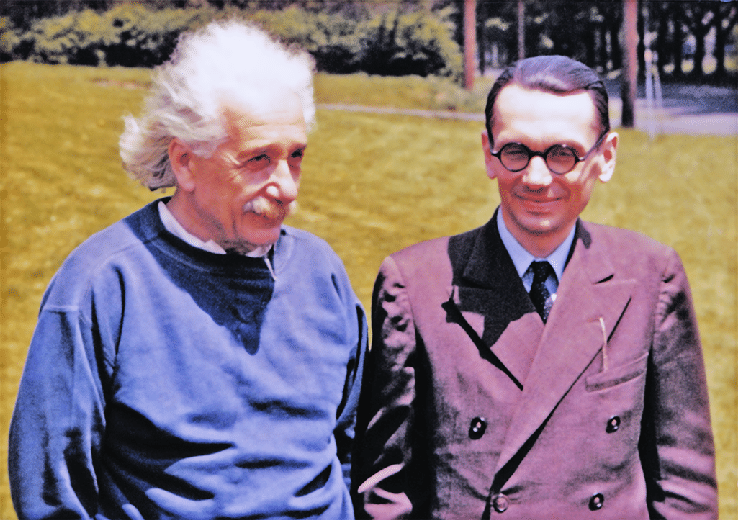
Today, Gödel is primarily known for his Incompleteness Theorems which can be regarded as formal elaborations on the foundational crisis in mathematics that Bertrand Russell had previously identified. In the same vein, his deliberations on general relativity can be seen as an elucidation of Husserl’s crisis of the European sciences. To the phenomenologist’s dismay, the Kantian approach was entirely abandoned and largely ignored within physics. At the latest, relativity theory would have debunked the Kantian assumptions of Newtonian space and time being hard-coded into our perceptive framework. For Gödel, however, relativity simply meant that Kant’s assumptions needed to be updated rather than discarded entirely. He understood Husserl’s concern over the situation that modern science was and still is faced with.
Ultimately, all modern sciences drifted into a peculiar, increasingly puzzling crisis with regard to the meaning of their original founding as branches of philosophy, a meaning which they continued to bear within themselves. This is a crisis which does not encroach upon the theoretical and practical successes of the special sciences; yet it shakes to the foundations the whole meaning of their truth. This is not just a matter of a special form of culture—‘science’ or ‘philosophy’—as one among others belonging to European mankind. […] Thus the crisis of philosophy implies the crisis of all modern sciences as members of the philosophical universe: at first a latent, then a more and more prominent crisis of European humanity itself in respect to the total meaningfulness of its cultural life, its total ‘Existenz.’
Husserl, Edmund. The Crisis of European Sciences and Transcendental Phenomenology: An Introduction to Phenomenological Philosophy. Translated, with an introduction, by David Carr. Evanston, IL: Northwestern University Press, 1970. [14]
With the removal of God from the equation, any transcendent principle was removed from science and our philosophical frameworks were constantly at risk of devolving into a mechanistic empiricism that would allow us to accumulate heaps of experimental data without having the guidance of an ontology that could meaningfully make sense of the data. Kant reconciled the Cartesian attempt to introduce the subject as an ontological mode with Humean empiricism, but he remained static in its categories. Hegel can be regarded as an heir to Kant insofar that he brought a dialectic dynamism into play that in hindsight could account for the discoveries of Einstein. By regarding the movement from Newtonian spacetime towards observed spacetime and back to Einsteinian spacetime as a thought movement in the Hegelian sense, we may be able to trace an intellectual tradition that eventual leads to Husserl and his search for Epoché.
Somit ergibt sich […] der unaufgelöste Widerspruch im höchsten Prinzip der Transzendentalphilosophie, der die vorausgesetzte und zugleich vermiedene Dialektik zeigt. Die Auflösung des Widerspruchs wäre das Denken der entgegengesetzten Seiten als Momente einer Denkbewegung: ‚Der Verstand ist er selbst nur als Tatsache und als Prinzip.‘ […] Dazu muss das Prinzip nicht als statischer ‚höchster Punkt‘, sondern als sichselbstbewegende Selbstidentität gedacht werden. Der Erscheinungsgegenstand ist nichts anderes als das Resultat der Selbstvergegenständlichung der Verstandesform. […] Die Frage nach der Existenz der Negativität wird Hegels Wesenslogik beantworten.
[EN]
Thus there emerges an unresolved contradiction in the highest principle of transcendental philosophy, showing a dialectic that is both presupposed and avoided. The resolution would consist in thinking the opposed sides as moments of a movement of thought: ‘Understanding is itself only as fact and as principle.’ […] The principle must not be thought as a static ‘highest point,’ but as self-moving self-identity. The phenomenal object is nothing other than the result of the self-objectification of the form of understanding. […] Hegel’s logic of essence will answer the question of the existence of negativity.
Gottschlich, Max. Die Überwindung der technischen Auffassung der logischen Form: Ein Ausblick von Kant auf Hegel. Hegel-Jahrbuch 2016, no. 1 (2017): 404–8. [10]
We perform the epoche … as a transformation of the attitude which precedes it not accidentally but essentially, namely, the attitude of natural human existence which, in its total historicity, in life and science, was never before interrupted. But it is necessary, now, to make really transparent the fact that we are not left with a meaningless, habitual abstention; rather, it is through this abstention that the gaze of the philosopher in truth first becomes fully free: above all, free of the strongest and most universal, and at the same time most hidden, internal bond, namely, of the pregivenness of the world.
Husserl, Edmund. The Crisis of European Sciences and Transcendental Phenomenology: An Introduction to Phenomenological Philosophy. Translated, with an introduction, by David Carr. Evanston, IL: Northwestern University Press, 1970. [14]
The Epoché is the sought-after core principle that may hold together the various sciences that otherwise are only bureaucratically tied together by their common affiliation with modern academia (McFadden [16]). As seen by Husserl’s famous student Martin Heidegger, this core principle takes us back much further than the scientific revolution or even the medieval period. It represents a fundamental break in our intellectual tradition and derives its importance from a millennia old misconception of forgottenness of Being (Seinsvergessenheit). It is the question of Being itself that is being raised and that leads us to dissolve our conceptions of time and space all the way back to when they were first conceived at the dawn of occidental philosophy.
If the question of Being is to have its own history made transparent, then this hardened tradition must be loosened up, and the concealments which it has brought about must be dissolved. We understand this task as one in which by taking the question of Being as our clue, we are to destroy the traditional content of ancient ontology until we arrive at those primordial experiences in which we achieved our first ways of determining the nature of Being—the ways which have guided us ever since.
Heidegger, Martin. Being and Time. Translated by John Macquarrie and Edward Robinson. Oxford: Blackwell Publishers, 1962. [11]
Phenomenology strives to return to the things themselves. It is a pursuit of restoration of an original, unaffected engagement with the world and its concepts. Naturally, it can never truly return to an imagined past as it stands in the history of being (Seinsgeschichte) at a point where it self-consciously disentangles itself from affections of what has hitherto been understood as metaphysics. The forgottenness of this metaphysical affliction has entered modern science to the extent that metaphysics has been pushed to the margins as a recreational activity with no direct bearing on modern research. This is occurring despite the fact that the inexplicability of quantum mechanics alongside its irreconcilability with general relativity should be seen as the clearest expression of Husserl’s crisis.
The effect of this event of phenomenological disclosure is that the phenomenon becomes its own language. […] Working toward an understanding of nature in Goethe’s way requires the further development of the scientist himself or herself. […] Thus, in Goethean science the scientist himself or herself has to become the instrument, and he or she has to participate actively in his or her own development in order to become this instrument. This is quite a different matter from just using instruments externally, e.g., microscopes and telescopes, to augment the senses.
Bortoft, Henri. The Wholeness of Nature: Goethe’s Way toward a Science of Conscious Participation in Nature. Hudson, NY: Lindisfarne Books, 1996. [4]
Experience reveals, beneath the objective space in which the body eventually finds its place, a primordial spatiality of which objective space is but the envelope and which merges with the very being of the body. As we have seen, to be a body is to be tied to a certain world, and our body is not primarily in space, but is rather of space.2
Merleau-Ponty, Maurice. Phenomenology of Perception. Translated by Donald A. Landes. London: Routledge, 2012. [17]
As explained in a previous section, time and space were not originally seen as things that were already given. Time and space were both created through ritual and familiarity. From the prevalence of frequented places, space was spaced in (eingeräumt) through an active participatory process. The world was fundamentally open and in flux without concrete boundaries with the exception of the bounded horizon, a boundary that was pregnant with all of the possibilities the world had to offer. Building, dwelling and thinking in its primordial sense represented a unit, a common process.
Only things that are locations in this manner allow for spaces. What the word for space, Raum, Rum, designates is said by its ancient meaning. Raum means a place cleared or freed for settlement and lodging. A space is something that has been made room for, something that—namely within a boundary, Greek peras. […] Space is in essence that for which room has been made, that which is let into its bounds.
Heidegger, Martin. Building Dwelling Thinking. In Poetry, Language, Thought, translated by Albert Hofstadter, 141–60. New York: Harper & Row, 1971. [12]
When a place is contemplated, it immediately strikes us in both a spatial and temporal sense. Which time effort is required to overcome this distance? This establishes distance. Our world has not changed. These distances are embodied as we can understand them on a deeper level if we can walk them. Distances of outer space, however, can be quantified in numbers, lightyears etc. but remain fundamentally incomprehensible. Towards the edges of our observable universe we too are bounded by a horizon. Same as with our primordial, worldly horizon, the boundary is not sharp but fades into an ever more distant, more diluted microwave background beyond which still remains the infinite potential of the unknown.
The embodied realisation of a distance builds the space around it. We know the distance and we are familiar with it. Our conception of space and time is our best guess at how the world is structured based on the familiar configuration of events and places. In more concrete, mathematical language we can understand observed distances as geodesics that constrain the range of possible spacetime manifolds that describe our world. In a Kantian sense, time and space retain their epistemological nature.
[1] Atmanspacher, Harald. Raum, Zeit und psychische Funktionen. In Der Pauli-Jung-Dialog und seine Bedeutung für die moderne Wissenschaft, edited by Harald Atmanspacher, Hans Primas, and Eva Wertenschlag-Birkhäuser, 239–274. Berlin and Heidelberg: Springer-Verlag, 1995.
[2] Atmanspacher, Harald, and Dean Rickles. Dual-Aspect Monism and the Deep Structure of Meaning. New York: Routledge, 2022.
[3] Bell, J. S. On the Einstein Podolsky Rosen Paradox. Physics 1, no. 3 (1964): 195–200.
[4] Bortoft, Henri. The Wholeness of Nature: Goethe’s Way toward a Science of Conscious Participation in Nature. Hudson, NY: Lindisfarne Books, 1996.
[5] Eddington, Arthur Stanley. The Nature of the Physical World: The Gifford Lectures, 1927. New York: The Macmillan Company; Cambridge, England: Cambridge University Press, 1929.
[6] Einstein, Albert, Boris Podolsky, and Nathan Rosen. Can Quantum-Mechanical Description of Physical Reality Be Considered Complete? Physical Review 47, no. 10 (1935): 777–80.
[7] Gödel, Kurt. Eine Bemerkung über die Beziehungen zwischen der Relativitätstheorie und der idealistischen Philosophie. In Albert Einstein als Philosoph und Naturforscher, edited by Paul Arthur Schilpp, 406–12. Braunschweig: Friedr. Vieweg & Sohn, 1979.
[8] Gödel, Kurt. “The Modern Development of the Foundations of Mathematics in the Light of Philosophy.” In Kurt Gödel: Collected Works. Volume III: Unpublished Essays and Lectures, edited by Solomon Feferman, John W. Dawson Jr., Warren Goldfarb, Charles Parsons, and Robert M. Solovay, 375–87. New York: Oxford University Press, 1995.
[9] Gödel, Kurt. An Example of a New Type of Cosmological Solutions of Einstein’s Field Equations of Gravitation. General Relativity and Gravitation 32, no. 7 (2000): 1409–17. Originally published in Reviews of Modern Physics 21, no. 3 (1949): 447–50.
[10] Gottschlich, Max. Die Überwindung der technischen Auffassung der logischen Form: Ein Ausblick von Kant auf Hegel. Hegel-Jahrbuch 2016, no. 1 (2017): 404–8.
[11] Heidegger, Martin. Being and Time. Translated by John Macquarrie and Edward Robinson. Oxford: Blackwell Publishers, 1962.
[12] Heidegger, Martin. Building Dwelling Thinking. In Poetry, Language, Thought, translated by Albert Hofstadter, 141–60. New York: Harper & Row, 1971.
[13] Heisenberg, Werner. Physics and Beyond: Encounters and Conversations. Translated by Arnold J. Pomerans. New York: Harper & Row, 1971.
[14] Husserl, Edmund. The Crisis of European Sciences and Transcendental Phenomenology: An Introduction to Phenomenological Philosophy. Translated, with an introduction, by David Carr. Evanston, IL: Northwestern University Press, 1970.
[15] Kant, Immanuel. Prolegomena to Any Future Metaphysics. Edited and translated by Paul Carus. 3rd ed. Chicago: Open Court Publishing Company, 1912.
[16] McFadden, Seán. Gödel’s Incompleteness as an Expressionof the Fragmentation of Epistemology in Mathematics and the Science. Kurt Gödel Freundeskreis. 2023.
[17] Merleau-Ponty, Maurice. Phenomenology of Perception. Translated by Donald A. Landes. London: Routledge, 2012.
[18] Misra, B., and E. C. G. Sudarshan. The Zeno’s Paradox in Quantum Theory. Journal of Mathematical Physics 18, no. 4 (1977): 756–63.
[19] Porro, Pasquale, ed. The Medieval Concept of Time: Studies on the Scholastic Debate and Its Reception in Early Modern Philosophy. Studien und Texte zur Geistesgeschichte des Mittelalters 75. Leiden, Boston, and Cologne: Brill, 2001.
[20] Rovelli, Carlo. Relational Quantum Mechanics. International Journal of Theoretical Physics 35, no. 8 (1996): 1637–78. Preprint, arXiv:quant-ph/9609002v2.
Atmanspacher and Filk (2013) developed a concrete model, the Necker-Zeno model, for bistable perception where reversal dynamics and perception dynamics are non-commuting operations on mental states ΦM. The model has been tested in a number of experiments and covers many diverse empirical observations successfully, even counterintuitive ones. The implications of this are severe, as it validates the mental aspect of observation and the potentially non-purely physical origin of quantum behaviour as the effect of observation of systems with no pre-given, fixed outcome.
Arguably, Merleau-Ponty conveys to us a more authentic description of what Aristotle likely implied in his understanding of space being essentially the delimitation of bodies. Body was most certainly not yet understood in the sterile Cartesian sense of pure empty geometricity. Instead, embodiment takes on a dynamic structure that varies depending on how much our bodies are involved in it. A space that we can traverse with our own body has carries a different meaning than one we can at best only observe at a distance. Hence we are faced with absurdity when confronted with the distances of outer space.